Covered Bridge Wingwall & Masonry Rehabilitation Project
Project Description
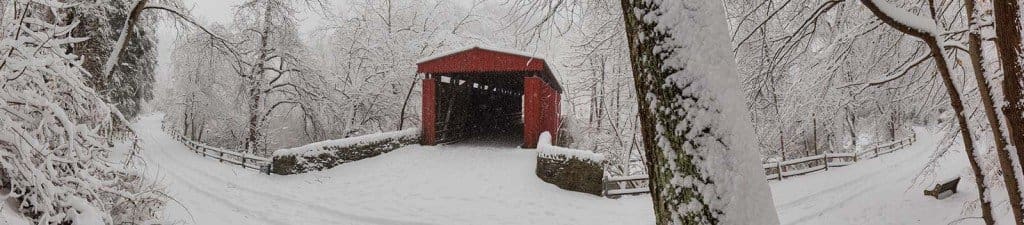
Friends of the Wissahickon will restore the Thomas Mill Covered Bridge’s wing walls, retaining walls, and surrounding masonry. Years of compounding stormwater events, erosion, and vegetation encroachment have contributed to deterioration of the wing walls and retaining walls. Rehabilitation of this masonry is critical to the overall integrity of the structure and contributes to its historic significance. Thomas Mill Covered Bridge, better known as the Red Covered Bridge, was first constructed in 1855. It is the only remaining covered bridge in a major American city. It is one of the most visited and photographed structures in Wissahickon Valley Park.
Restoration Goals:
- Repoint approximately 780 square feet of stone walls
- Rebuild approximately 240 square feet of stone walls
- Remove tree and roots from masonry
- Clean stone walls
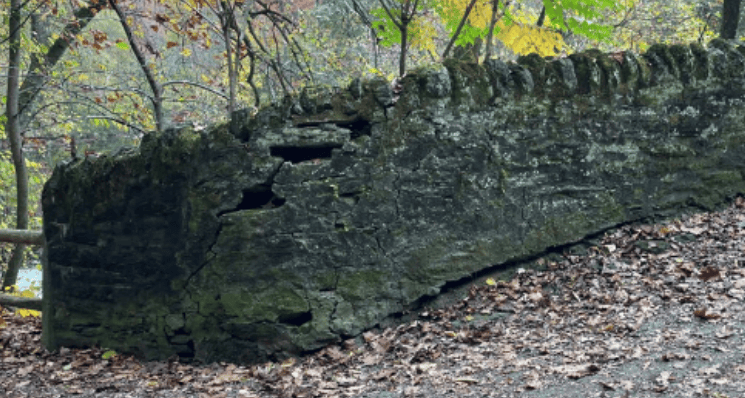
Northwest Wingwall Damage
Project Partner: Philadelphia Parks and Recreation
Status: Fundraising Phase
This project is partially funded through the Pennsylvania Historical and Museum Commission’s Keystone Recreation, Park and Conservation Fund and an anonymous donor.
FOW is continuing to seek support for this project, thank you for considering a donation. If you have any questions, please reach out to capitalprojects@fow.org
Bridge History

View of the Covered Bridge from the NE
Thomas Mill Covered Bridge connects Wissahickon Valley Park’s 2.6 million annual visitors to Pennsylvania’s architectural, industrial, and cultural history. One of only a handful of bridges spanning the Wissahickon Creek in Wissahickon Valley Park, the Covered Bridge connects the Park’s trail system and the Roxborough and Chestnut Hill neighborhoods in Northwest Philadelphia. It is part of the Wissahickon Valley’s rich history as an industrial powerhouse in the late 17th and early 18th centuries, when mills were built up and down the Creek and its tributaries.
In 1717, a grist mill and road were constructed next to the Creek. Twenty years later in s added, extending the road over the Creek. While official recorded dates across historic documents vary, the National Register of Historic Places records that, in 1855, the Thomas Mill Covered Bridge was constructed to replace its predecessor as the mill continued to flourish. Twenty years later in 1737, a bridge was added, extending the road over the Creek. While official recorded dates across historic documents vary, the National Register of Historic Places records that, in 1855, the Thomas Mill Covered Bridge was constructed to replace its predecessor as the mill continued to flourish. The Covered Bridge served as a crossing for horse-drawn vehicles carrying materials between the farms, mills, and markets. In 1871, the Fairmount Park Commission (now Philadelphia Parks & Recreation, PPR) purchased the mill and allowed its operation to continue until 1884, when it was demolished. Ruins of this mill are still visible to park visitors.
Based on plans drawn by Fairmount Park Commission engineers and with funds from Friends of the Wissahickon, Works Progress Administration staff rebuilt the bridge in 1938 and 1939 and added reinforced steel. The Covered Bridge was again rebuilt in 1999 by the Fairmount Park Commission, which saw the removal and replacement of the siding, decking, and rafters with about 50% salvaged original materials and the replacement of its wood roof with a standing-seam, stainless steel roof.
Today, the bridge is popularly known as the “Red Covered Bridge”. It serves as a connection to history, a crossing for Park visitors, and hosts an average of approximately 979 daily visitors.
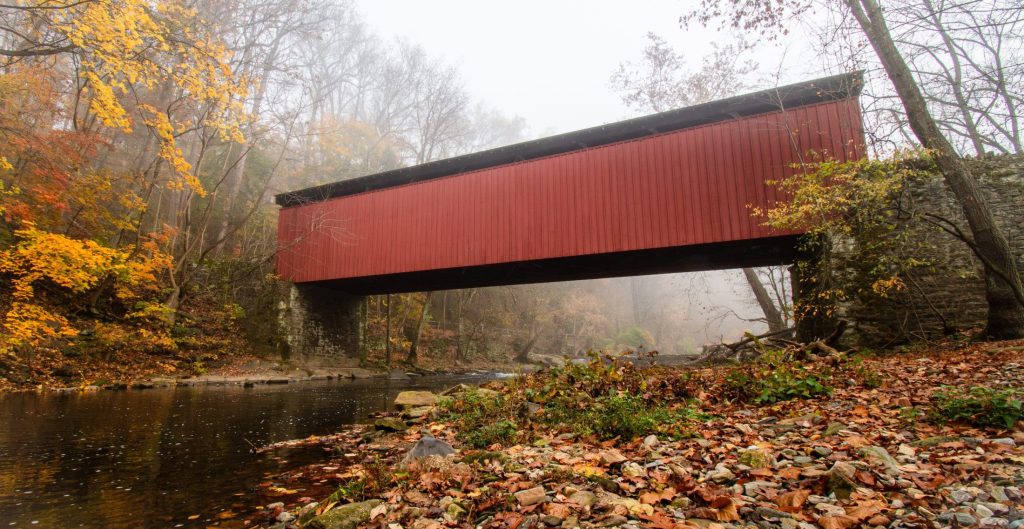
View of Thomas Mill Covered Bridge from the SE Streambank