Amphibian Friends in Philadelphia
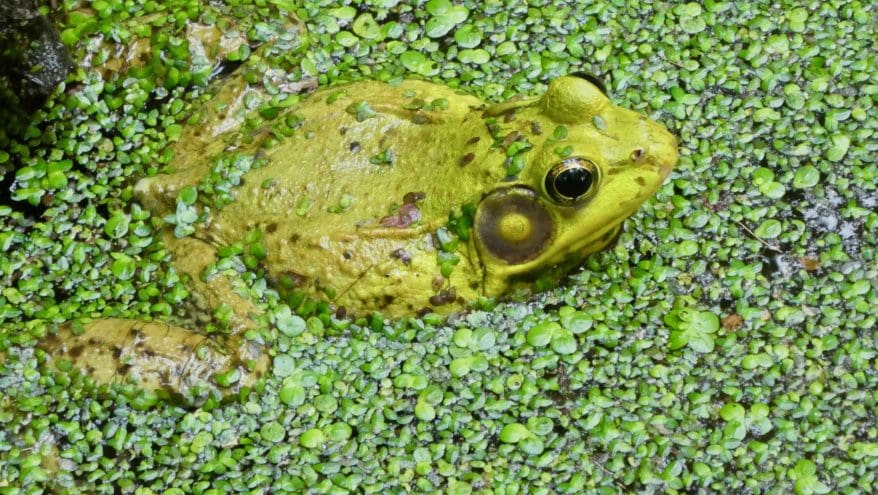
by Susan Slawinski
Volunteer & Community Outreach Manager, Schuylkill Center for Environmental Education
You don’t have to go far to see amphibians in the city of Philadelphia, but you do need to know where to look, and sometimes listen, in order to find them. This hobby is often called “herping,” which stems from herpetology, the study of amphibians and reptiles. Amphibians are defined by their unique lifecycle, with many species adapted to live on both land and water at different stages of development. This includes frogs, toads, newts, salamanders, and caecilians.
Timing is key. Activity levels vary with the seasons and time of day. Pickerel frogs (Lithobates palustris), green frogs (Lithobates clamitans), American toads (Anaxyrus americanus), grey tree frogs (Dryophytes versicolor and Dryophytes chrysoscelis), and American bullfrogs (Lithobates catesbeianus) can be heard calling around ponds on warm, spring, evenings, hoping to attract mates. Some species of frogs and toads exhibit eyeshine, meaning that their eyes reflect back light when a flashlight is directed at them, making them easier to spot at night.
Most amphibians require access to water or a reliably moist environment. Eggs typically have a jelly-like quality and must remain wet in order to thrive, hatching into tadpoles and salamander larvae. Still or slow-moving bodies of water are your best bet to find egg masses. American toads have a particularly unique looking egg mass, as eggs are laid in a long curled string numbering up into the thousands. The eggs of the red-backed salamander (Plethodon cinereus) are laid on land, often in rotting logs or under rocks, protected by the dark, damp shelter and guarded by their mother until they hatch.
Camouflage is a common defense mechanism for amphibians, with many looking to blend in with leaf litter, tree bark, and aquatic vegetation. However, some take the opposite approach through aposematism, using bright colors and patterns to warn potential predators they are not worth eating. The red eft, which is the juvenile stage of the eastern newt (Notophthalmus viridescens), is bright orange and produces a neurotoxin called tetrodotoxin. The reddish-orange skin with black spots of the red salamander (Pseudotriton ruber) contains poison called pseudotritontoxin.
A great way to encounter amphibians is through community science programs. For example, the Schuylkill Center for Environmental Education hosts Toad Detour each spring, where volunteers close off a section of roadway to allow for frogs and toads to cross during their breeding migration from the forests to the Roxborough Reservoir. Please note that if you plan to explore independently, a valid Pennsylvania fishing license is required to catch or handle all species of reptiles and amphibians in the state. When flipping rocks and logs, put them back exactly as they were, being careful not to squish any critters underneath. Because many species of amphibians absorb oxygen and water through their skin, any oils, soaps, and lotions on your hands can hurt them, so it is best to avoid touching them if possible. While searching for amphibians is a great way to learn, please make sure that you do so in a way that respects both the animals and their environment. Happy herping!