Here’s a Bright Idea—Turn Off Your Lights for Dark Sky Week!
by Bill McGeeney, FOW Crew Leader
What is Dark Sky Week?
Did you know that you could once see the Milky Way from the city confines of Philadelphia? It’s true! I can’t say exactly when it disappeared from sight, but judging by parallel occurrences in other places in the industrialized world, it probably occurred sometime in the early 1920s. Even in Paris, the City of Lights, you could still make out a fading Milky Way upwards of the years leading up to World War I.
Dark Sky Week sounds intimidating because it has a word that seems to have only negative connotations in our society. That word unfortunately is ‘dark.’
I want to stress what Dark Sky Week isn’t. It’s not dark streets, it’s not dark pavements, and it’s not dark sidewalks. It’s not dark alleyways. It’s simply Dark Sky.
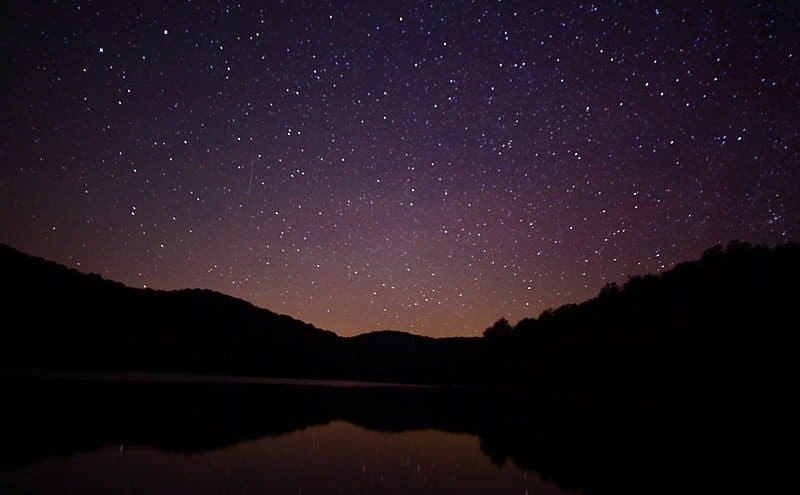
So what does Dark Sky mean? It means Starry Sky.
When was the last time you went to an event outside, “under the stars?” You might have noticed that you could see a few bright stars…and probably nothing more. Heck, you might have only noticed one the big dipper because that’s all that was visible.
Believe it or not, we have made night extraordinarily bright! If you don’t believe me, simply step into a dark room on a cloudy night and notice how much light actually is entering that room! The clouds are even a pale white at night!
Proclamation
Recently, Governor Josh Shapiro released a proclamation recognizing Dark Sky Week to,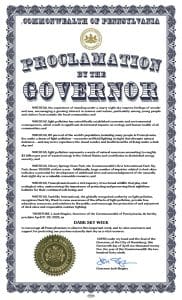 “encourage all Pennsylvanians to observe this important week, and to raise awareness and support for protecting our precious naturally dark sky as a vital resource.”
What can the average person do to reduce their contribution to light pollution, this week and beyond?
The good news is that this is a pretty simple form of pollution to fix. It just takes a little forethought.
First, take inventory of your exterior lights. Identify what their purpose is. If they have no purpose, do they really need to be on? For the ones that have a clear purpose, could they be switched over to motion detectors? If that isn’t the case, or you simply don’t feel comfortable with motion detectors, look at where the light is actually going.
If the light tends to shine up the side of your neighbor’s house, much of that light is serving no practical purpose, other than potentially annoying your neighbor. Rather, aim the light down to the ground or use recess lighting if possible, but don’t aim the light outward.
Following this basic step provides the added bonus of reducing the propensity of encountering glare at night. Glare can be dangerous and may temporarily blind you from seeing your whole surroundings.
All light at night serves a purpose, and that goes both ways for the good and the bad guys. People seem to treat a natural nighttime as some fantasy world where little trolls wait behind a tree to get you. Well, that’s not the case, bad guys use light to see, too. Contrary to popular thoughts about darkness, they don’t possess superhuman powers.
What do the effects of light pollution look like for us and our furry friends?
Many of the human effects of light pollution stem from our inability to have dark nights and bright days. When people say, sure you can solve light pollution by simply getting black out curtains, they miss the point that your body also requires bright mornings to restart its daily cycle.
There’s a sizable amount of research out there on human health’s impacts from artificial light at night – both inside and outside. The common consensus is that colder – whiter colors are worse for you than warmer colors. However, what’s often forgotten is that you require darkness at night. What the research appears to point out is an association between misaligned circadian rhythms and metabolism related issues, think diabetes. In some cases these circadian imbalances have been linked to certain types of cancers.
On the ecological front, it’s abundantly clear that artificial light at night has become another major stressor in our environment. Artificial light at night changes localized ecosystems, often by shifting the predator – prey hunting balance. Predators will leverage light to continue hunting well past hours where they otherwise wouldn’t. This is true for everything from land-based mammals, to birds, even to aquatic ecosystems.
Light at night appears to be a piece of the pollinator dilemma. Nighttime pollinators like moths get lost in all types of artificial lights at night due to evolutionary flight orientations that used natural nighttime light (think lunar and stellar) as navigation guides. Bees have shown an aversion to artificial light at night, preferring dark areas and even experiencing an apparent cognition decline when exposed to artificial light at night.
It’s been found that artificial light at night not only impacts where birds fly to but also affects some species’ cognition abilities and hatchling success. Artificial light at night has even been demonstrated to reduce soil aeration by driving earthworms underground. While plants tend to grow more under artificial light, the constant conversion activity of the light into energy thickens some species’ cellular density and reduces the ability of insects to feed on them.
The general rule of thumb for most species is that red light appears to have the lowest impact, white light appears to have the highest impact. However, due to how various species evolved, this rule of thumb isn’t 100% universal. That’s why when in doubt, no light is best.
Can the problem of light pollution be fixed entirely or just improved?
That’s a loaded question. It can be fixed entirely though most people would prefer not to live in such a world. So the real question is, what can we do to lessen the impact. All artificial light at night is a pollutant. However, we as people feel safer with it. So let’s strike a balance, which is, honestly, pretty easy to do!
The Illuminating Engineering Society and Dark Sky International developed a joint framework called the five principles of good lighting. By following these principles, we can create a sustainable night that both allows us to feel safe, and protects our health and our ecological space.
1) Ensure your light has a purpose. It should have a clear purpose.
2) Ensure the light is targeted only where you need it. If the light is trespassing beyond where you need, consider repositioning it or installing shielding. (Side note – if the newly installed LED street lights are trespassing light into your property, you can request light shielding through ledstreetlighting@phila.gov).
3) Use the light only when it is needed. Choose motion sensing lights over always on. Use a timer for decorative lighting on your house and in your yard.
4) Use warm colored lights ideally less than 3000K in color temperature.
5) Start with the lowest level of brightness and go higher, rather than vice versa. Lower power lights reduce the propensity of glare and can aid your body’s natural night vision. If you need something stronger, no problem, but start low first. You may find that it works surprisingly well.
Night doesn’t need to be a trade off between lights on and lights off. By putting thought into our lighting, being cognizant of the effects it has on our neighbors, on our health, and on the environment, we can have both the stars above and a feeling of comfort at night.
But in order to go down that road, we need to first accept that losing night is a problem and take ownership of how our actions and decisions in regards to something as small as how we utilize light affects others.