The American Woodcock: A Shorebird That Prefers the Forest!

by Susan Haidar
Wissahickon Environmental Center, Environmental Education Planner
The American Woodcock (Scolopax minor) is a short, stocky bird with a long beak that looks similar to a bird in coastal areas and wetlands. Its relatives include sandpipers, snipes, and curlews. But the Woodcock, also known as the Timber Doodle, Labrador Twister, and other amusing names, resides in shrubby fields and young forests, often near open fields. It is well camouflaged for these areas with back and wing feathers that are a mixture of browns, tans, and grays. With its long beak, it probes the ground for earthworms. It has large, dark eyes set upward and towards the back of the side of its skull, enabling it to see an approaching predator. The Woodcock is a funny-looking bird with such a long beak disproportionate to the size of its short body!
Woodcocks only raise one brood of young per year, usually numbering four chicks. They build nests on the ground in a wooded location. The nest is a shallow, hollowed-out area covered by leaves and twigs. Unlike many song birds, chicks can leave the nest within a few hours of their birth and will begin hunting worms in a few days. Within two months the young birds leave the family.
Sixty percent of a Woodcock’s diet is worms; they also feed on insect larvae, invertebrates, and plant matter. During dry periods when worms tunnel further underground, this assures another food source. The bird has the unusual ability to open the tip of its upper bill (mandible) while it is underground, helping it to snag a worm. It also moves its body forward and back as it walks. This is thought to stimulate worm movement that the bird can hear or sense.
In our region, in October and early November the Woodcock migrates south to Eastern coastal states for the winter. The bird is a nighttime migrant flying at low altitudes of 50 feet or so. Unfortunately, some collide into buildings. It returns in late February or early March.
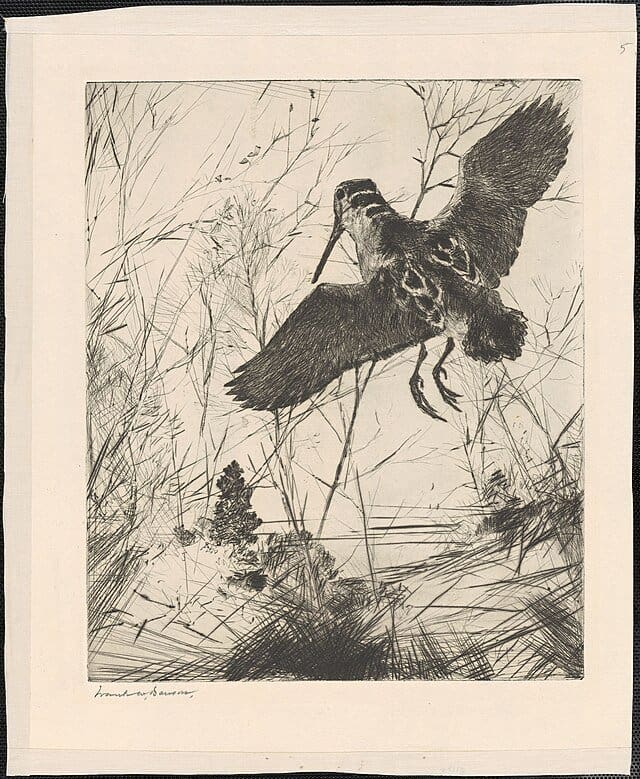
Woodcock “Sky Dance” by Frank Weston Benson, Wikimedia Commons
Woodcocks are notoriously hard to see, except in early March, the beginning of their mating season. At this time, the male bird performs an evening display designed to impress a potential mate. When observing, first, you listen for the bird calling “peent, peent.” Then, the bird flies straight up in a spiraling motion. The higher it ascends, the more you hear a twittering sound produced by the bird’s wings. At 200 to 350 feet high, it descends downward again, making chirping sounds. Since it is dark when the Woodcock’s show begins, rather than seeing a clear image of the bird, you see a fast-moving, shadowy image of something flying quickly up from the ground past your head!
Woodcock populations have declined due to loss of habitat from residential development and natural forest maturation. From 1968 to 2012, Pennsylvania’s population was decreasing one percent per year. Luckily, in the last ten years the state’s eastern population has stabilized. The Woodcock is a game bird in Pennsylvania, although not very popular with hunters.
Three years ago, in mid-February, I was lucky enough to have a Woodcock land in my backyard! This experience was by far my best view ever of the bird. I live close to John Heinz NWR and speculated the bird was on its way there and chose my yard for a resting stop. It wandered into the next yard and started probing the ground for earthworms until it saw a stray cat in the alley and flew off.

Courtesy of Fyn Kynd, Wikimedia Commons
Tony Croasdale, the supervisor of the Wissahickon Environmental Education Center, has led walks to observe displaying Woodcocks for nearly twenty years. Tony first led Woodcock trips when he interned at John Heinz National Wildlife Refuge. While Heinz has a reliable woodcock display area near the main entrance, the best place is outside the refuge’s border. This Woodcock hotspot at the end of Lindbergh Boulevard is a parcel of undeveloped city land known as the Eastwick Meadow. Tony switched to leading Woodcock walks at Houston Meadow after he started working for PPR. Tony’s best Woodcock display experience was accidentally discovered at Temple’s Ambler Campus, where he instructs an evening Plant Ecology course in the spring. While waiting for his Uber behind Temple Ambler’s Learning Center, he sometimes sees dozens of Woodcocks displayed over the field and in the parking lot! The campus’s floodlights illuminate the displaying birds. Tony thinks any brushy field near the woods can host Woodcock displays. For instance, FDR Park in South Philly has Woodcock displays, and Tony has flushed Woodcocks in Andorra Meadow, Cobbs Creek Park, and along the Schuylkill River Trail. You may discover the next Woodcock hotspot!