A New Program to Steward 2,000 Acres of Parkland
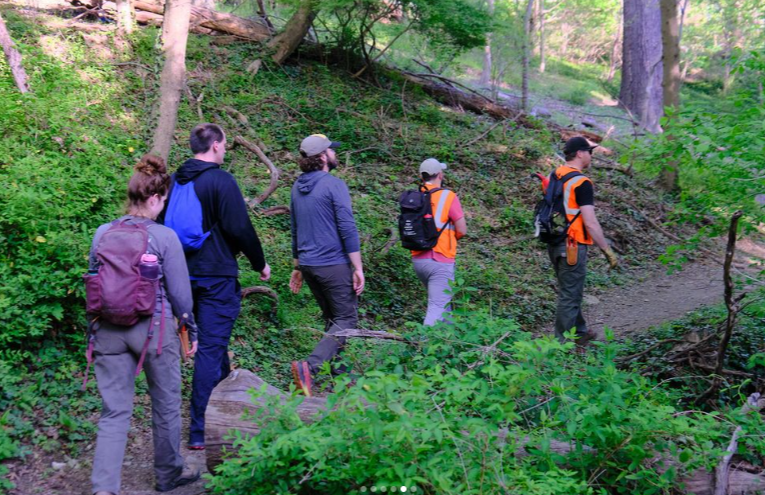
The Wissahickon is home to over 2,000 acres of wetlands, forests, and meadows, 50 access points, 50+ miles of trails, 24 miles of waterways, and a vast landscape to conserve. We’re proud to have stewarded this fantastic urban park for a century, but we certainly have not done it alone.
Friends of the Wissahickon rely on our broad base of volunteers to tackle the essential work required to conserve and beautify a park for our 2+ million annual visits and the native habitat. Our over 1,500 annual, unique volunteers help us with everything from litter cleanups to trail reroutes.
Our Trail Ambassadors allow us to improve the visitor experience by working as our park docents, Crew Leaders expand our capacity for stewardship by assisting at volunteer days, and our specially trained group of volunteers even help us remove downed trees from the trails! Two years ago, our volunteer scope of work grew even wider.
In 2022, after a particularly large Crew Leader volunteer recruitment, a dream of our Director of Field Stewardship, Shawn Green, to expand and strengthen our reach across the park came to fruition: the Zone Stewards Program.
“We welcomed 20 Crew Leaders in 2022, the largest class we’d had up until that point,” said Shawn. “They are trained in everything that makes up the park: fauna, geology, the watershed, and how to protect it. With such a large group of trusted volunteers, it felt like the perfect time to split up the park and assign them a section to look after.”
Zone Stewards work independently to organize their own volunteer days with fellow FOW volunteers, neighbors, and friends. They have a slate of regular tasks: cutting back sightlines to mitigate user conflict, pulling out invasives, and reporting larger issues like erosion to our Field Team in their designated 100-acre section of the park. The program has proven to be an effective way to reach and care for some of those lesser-traveled sections of the park.
“There is a funny thing that happens to your perspective as you go through the training process to become a FOW Crew Leader and Zone Steward,” said Andrew Cronin, Zone Steward for sections 13, 14, and 15.
“The FOW staff warns you that once you know the details of the work that needs to be done to care for the park, the only things you can see are problems. The volume can seem overwhelming, but the magic of the Zone Stewards program helps to reframe the work into segments, creating stewardship areas that enable meaningful contributions to the park’s environment through regular attention from small groups of volunteers.”
In the program’s first year, the Zone Stewards focused their efforts on the park’s eastern side; the next year, they switched to the western side. This year, each Zone Steward has a primary zone which they survey first; if there’s no work to be done, they hop over the Creek to their secondary zone to do the same work.
We hope that one day soon, we’ll have enough Zone Stewards for each park section of the Wissahickon, so each zone has consistent and comprehensive care. Thanks to our dedicated volunteers and their constructive feedback, we’re evolving to the ever-changing needs of the park more effectively than ever before. In 2023, our Zone Stewards improved 32+ miles of trail!
The program, which is now required for first-year Crew Leaders, not only furthers their development as trained volunteers but also serves as an introduction to land conservation and teaches Crew Leaders how to identify and resolve problems in the park independently.
“The Wissahickon is home to some of the finest urban trails in America, but they don’t stay in pristine shape on their own,” said Aaron Aleiner, Zone Steward for sections 14, 15, and 16. “It takes a lot of hard work from some very dedicated and skilled people.”
We’re no strangers to hard work. We’ve been in the park conservation game for 100 years now! We’re excited that more and more people are becoming connected to the Wissahickon, but as visitorship increases, our capacity for its care must grow so we can ensure the park is a place we all want to visit!
“It’s rewarding to see the impact this approach can have: trails that were trash-strewn, overgrown, or washed out when we started have been transformed, becoming more welcoming and ecologically healthy every time we go out,” said Aaron.
“Together, we can restore and preserve the grandeur of the Wissahickon for generations to come.”
Want to make a meaningful impact? Get involved with our volunteer core. Find out how to get started at fow.org/volunteering.
For more information about our 100th anniversary, visit our website fow.org/100years.